
Answer-first summary
Lowering springs are cheaper, simpler and a reasonable choice if you want a modest drop without much fuss. Coilovers cost more but give you genuine adjustability over ride height and, on better kits, damping. Both can pass an MOT and both are road-legal in Great Britain, provided the setup does not cause tyres to rub, suspension to bind or handling to become dangerous. The wrong choice is buying cheap coilovers when quality springs would have served you better.
How this guide was researched
No first-hand ownership or test evidence has been supplied for this article. All ride quality, handling and installation characterisations below are drawn from public secondary sources, which are cited throughout. Specification details are kept separate from any performance claims.
What is genuinely good
Lowering springs: simplicity and cost
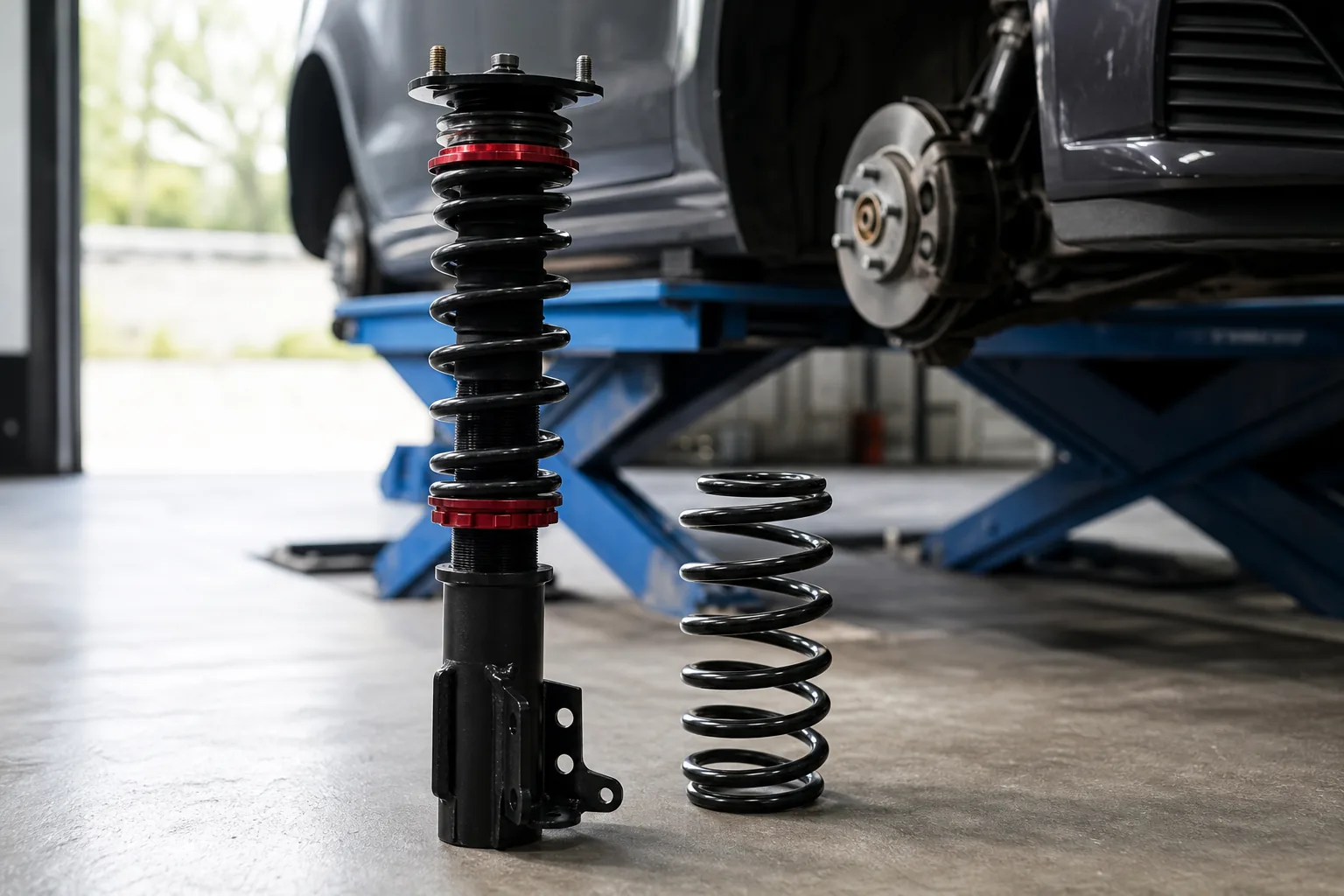
Lowering springs replace your factory springs with shorter units wound to a higher rate. The standard dampers stay in place unless you choose to replace them at the same time. The drop is fixed at manufacture. A typical kit lowers a car somewhere between 25 mm and 40 mm, depending on the vehicle and the brand. You cannot adjust that once the springs are fitted.
Spring rate is how much force is required to compress a spring by one unit of distance. In metric terms, that is expressed as kilograms per millimetre (kg/mm). A higher rate means a stiffer spring with less body movement. A lower rate gives more compliance over poor surfaces at the cost of more roll.
The strength of lowering springs is the price of entry. Parts run from roughly £150 to £400, with an Eibach Pro-Kit sitting at around £200 to £350. Labour is approximately £150 to £300, and four-wheel alignment afterwards runs about £80 to £120. Total installed cost for a quality setup comes in at roughly £380 to £770. For a daily driver that just needs a cleaner stance and slightly sharper turn-in, that is good value.
Some brands sell matched spring-and-damper packages. These are better tuned than springs paired with stock shocks and reduce the main ride quality risk, though the height remains fixed with no further adjustment.
Coilovers: adjustability that earns its price
Coilovers replace the spring and damper together as a single unit. The ride height is adjusted by moving the spring seat up or down the shock body, which means you can change how low the car sits without altering the spring rate. If you want a stiffer or softer spring, you swap the spring and reset the seat to your preferred height. Many coilover kits also allow damping adjustment, giving you control over how the suspension responds to bumps and body movement.
That adjustability is the core argument for coilovers. For daily or weekend road use, lower spring rates and progressive damping work best; typical street-friendly rates cited in secondary sources run around 6 kg/mm front and rear, or a split such as 7 kg/mm front and 5 kg/mm rear depending on the platform. A harsh ride from a coilover kit is usually a sign of a cheap build or incorrect damper settings, not an inherent flaw of the system.
Mid-range coilovers (£800 to £1,500 for parts) and premium kits (£1,500 to £3,000 or more) offer build quality and damping sophistication that justifies the outlay if you intend to tune the car over time. Labour runs £300 to £600, plus the same £80 to £120 alignment. At the premium end, total installed cost reaches £1,880 to £3,620. Serious money, but money that buys genuine flexibility.
What is not
Lowering springs on stock dampers
The main risk with lowering springs is a mismatch between the new spring and the factory damper. The stock shock absorbers were not designed for the shorter travel and different spring rate, which can produce a bouncy or unsettled ride and wear the dampers out faster than normal. If you are keeping the original shocks, you need to accept that compromise or budget for matched dampers on top.
Budget coilovers
Coilovers in the £400 to £800 range have a reported lifespan of only two to four years and can be harsh in daily use. If your budget sits at that level, quality lowering springs from a reputable manufacturer are often the more sensible choice. You are not saving money by buying the cheapest coilovers. You are buying a harsher ride and a shorter service life.
For baseline context, Checkatrade data from May 2024 puts the average UK cost of a standard front coil spring replacement at around £225 and rear at around £172, parts and labour combined. Those are non-modified figures, useful for understanding what the labour component alone might look like on a spring swap.
MOT risk from poor execution
The GOV.UK MOT Inspection Manual, Section 5 sets out what testers check on suspension. The criteria are: components must be secure and correctly located; corrosion must not be excessive; damping must be adequate; suspension travel must be adequate; and nothing must foul the bodywork or tyres.
There is no rule in the MOT regulations that says a car must sit at factory ride height. Lowering itself is not a fail reason. What fails cars is sloppy execution.
As of 24 June 2025, the MOT manual was updated to tighten the definition of “insecure”. A safety-critical component, which includes suspension components, must now be “safely or completely attached at its fixing or to an associated component.” That wording matters for aftermarket spring platforms and coilover top mounts. If a top mount is not correctly torqued or a spring platform is not fully seated, a tester has clear grounds to reject the car.
Coilovers set too low create a cluster of specific failure points. Inner tyre walls can rub on arch liners, bump steer can develop, and ABS sensor wiring can be compromised. Any of those will flag at inspection. The fix is straightforward: ensure the car has adequate suspension travel, that bump stops are not permanently compressed, and that tyres clear all bodywork through full steering lock and full suspension compression.
MOT testers have discretion. A correctly set up lowered car should pass. Nothing in MOT regulations guarantees a pass, and no article can promise one. Get the setup right before you book the test.
Road legality sits on you, not on the MOT certificate
The Road Vehicles (Construction and Use) Regulations 1986 govern how a modified suspension setup must behave on a public road. The full text of the suspension-specific provisions should be checked directly at that link.
The practical position, as stated by the Dorset Road Safe Partnership, is this: if the suspension is so low that handling becomes dangerous, or wheels and tyres make contact with bodywork, that is an offence. The UK does not publish a minimum ride height in millimetres, but it does require that the car’s handling and safety systems are not compromised. Tyres must be fully covered by arches at all times, including through full steering lock.
Passing an MOT confirms the car met inspection criteria on that day. It does not certify compliance with every Construction and Use Regulation. These are separate legal questions.
Every modification, including suspension work, must be declared to your insurer. Any change that affects performance, safety or appearance must be disclosed. Failing to declare suspension work is not a grey area. It is grounds for a voided policy.
If you are in Northern Ireland, the relevant authority is the Driver and Vehicle Agency rather than the DVSA. DVA rules should be verified directly, as they may differ.
Compared to alternatives
Lowering springs and coilovers are the two main routes for dropping a car’s ride height, but they are not the only suspension modifications worth considering.
A matched spring-and-damper kit from a brand like Bilstein or KW sits between the two options in cost and capability. You get springs and shocks designed for each other, which avoids the stock-damper mismatch problem, but ride height remains fixed. These kits typically cost more than springs alone but less than a mid-range coilover setup.
Air suspension is a different proposition entirely. It allows ride height adjustment on the fly, which solves the everyday-versus-show dilemma, but the cost is substantially higher (often well above the premium coilover bracket) and the added complexity brings more maintenance. For a daily driver on a realistic budget, air is usually overkill.
For anyone considering coilovers purely for track use, dedicated motorsport dampers with helper springs and adjustable platforms are the proper tool. These are not road-friendly and should be treated as track-only kit.
Who should buy it
Lowering springs suit you if:
- You want a modest, predictable drop on a car you drive daily.
- Your budget is under £800 all-in.
- You do not need to adjust ride height between uses.
- You are buying from a reputable brand and ideally pairing with matched dampers.
Coilovers suit you if:
- You want to tune the car over time, adjust for track days, or run different heights seasonally.
- Your budget stretches to mid-range or above.
- You understand that getting the spring rate wrong for your use case will make the car unpleasant to drive.
- You are prepared to spend time setting the car up correctly rather than bolting it on and hoping.
Neither option suits you if:
- You are buying budget coilovers to save money over quality springs. That is not saving. That is buying problems.
Verdict
Lowering springs win on simplicity and value if the drop you need sits within what a good kit offers and you have no intention of changing it. Get a reputable brand, pair with matched dampers if you can, align the car properly and you will have a tidy setup that passes an MOT without drama.
Coilovers win on flexibility, but only from the mid-range upwards. The adjustability is real and useful, particularly if the car sees track time or you want to dial in the setup over multiple seasons. Budget coilovers tend to produce the worst of both worlds: stiff, short-lived and no better at passing an MOT than a quality spring setup.
Whichever you choose, keep the suspension travel adequate, keep the tyres inside the arches, torque everything properly and tell your insurer. Those four things keep you legal, keep you on the road and keep the build from becoming an expensive mistake.
Alignment is not optional after either job. Book it when you book the fitting.