
The short answer
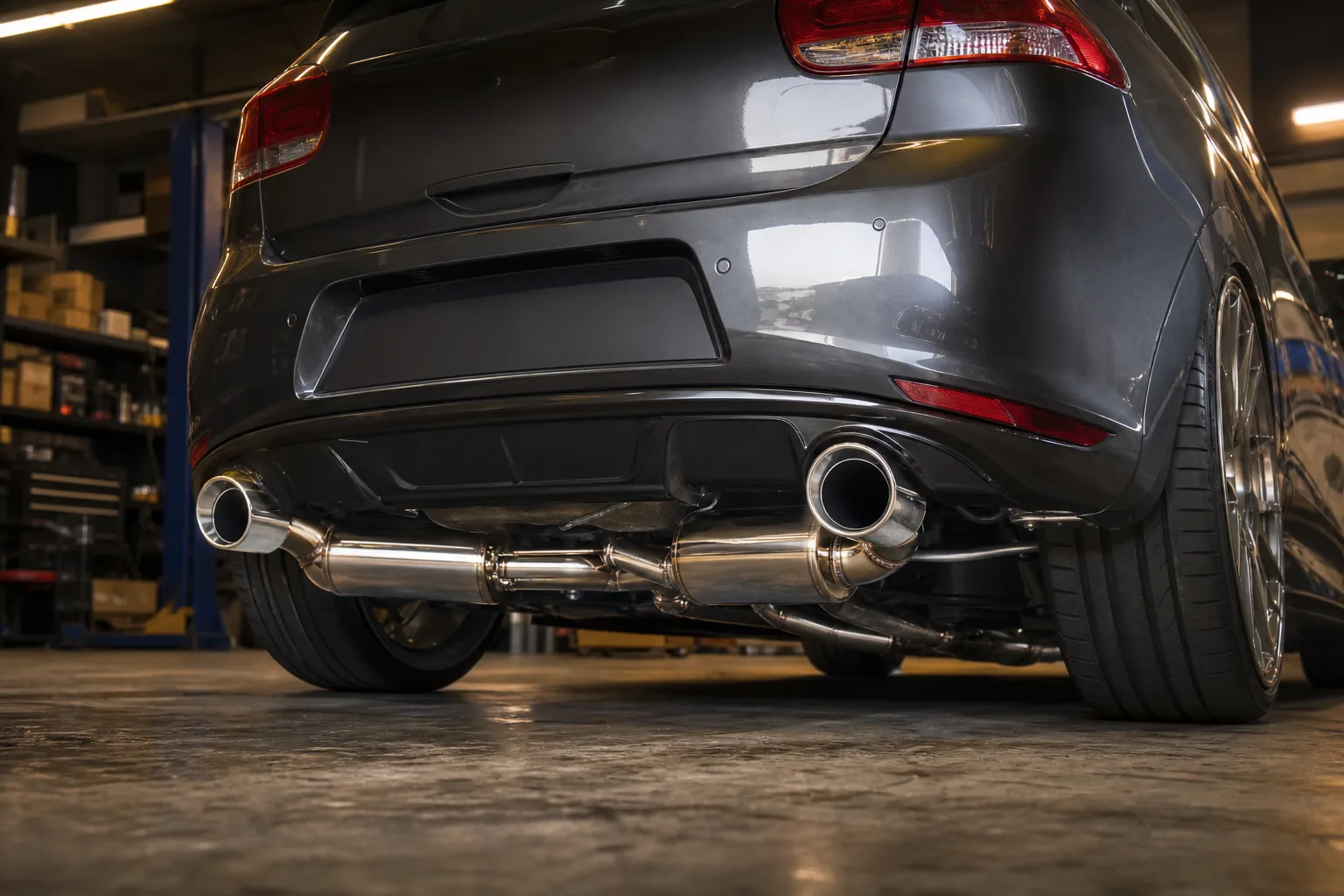
A louder exhaust is not automatically illegal, but an exhaust that is noisier than the one your car left the factory with probably is. Regulation 54(2) of the Road Vehicles (Construction and Use) Regulations 1986 applies in Great Britain and it is clear: you must not alter your exhaust system in a way that increases the noise made by escaping gases. The MOT test has no decibel meter. The police have discretion, and enforcement is growing.
Here is how to get a sound you are happy with without writing yourself a fixed penalty or an MOT failure.
Where the rules come from
It is a breakdown of the rules that govern every exhaust upgrade you will ever fit to a road car in Great Britain, plus the track day limits that let you enjoy the loud stuff legally.
Regulation 54(1) requires every petrol or diesel car to have a silencer through which exhaust gases pass before reaching the atmosphere. Regulation 54(2) says that silencer must be kept in good working order and must not be altered to increase noise. That covers both modifying the silencer itself and swapping it for a different pattern that makes more sound.
This applies in England, Scotland and Wales. Northern Ireland has separate road traffic legislation and the 1986 Regulations do not extend there.
You will read 72 dB or 74 dB quoted online as “the legal limit”. Those figures come from type-approval drive-by testing at 7.5 metres, which is how a new car earns its approval before sale. They are not a single enforceable roadside number for every car on every road. The statutory obligation for a car already in service is simpler and stricter than any fixed dB figure: do not be louder than you were from the factory.
How police and testers enforce noise
Essex Police’s published enforcement procedure gives a clear picture of how officers approach noisy exhaust stops today. Exhausts must not be altered or replaced in a way that increases noise above the type-approved level. The procedure distinguishes between readings of 80 to 89 dB and readings above 90 dB, with different disposal categories for each band. Officers can issue fixed-penalty notices for excessively noisy exhausts and, in some cases, the vehicle can be taken off the road until the system is corrected. Verify the current penalty amount at GOV.UK before budgeting for the risk, as the figures cited in secondary sources may be out of date.
Enforcement is not just an individual officer’s mood any more. Research published in January 2025 by Intelligent Transport Systems UK found that 69 per cent of 2,050 people surveyed wanted easier enforcement against noisy vehicles, and 62 per cent supported the rollout of noise cameras. Political appetite for action is there.
The MOT side has not changed in principle but is worth understanding. The DVSA has confirmed that the MOT test includes a thorough inspection of exhaust condition, but testers use experience and judgement to make a subjective assessment of noise. There is no meter and no fixed dB pass or fail line. The examiner listens at idle and under a rev to roughly 2,500 rpm or half the maximum engine speed. DVSA defect 8.1.1(a) instructs them that exhaust noise must not be unreasonably above the level expected from a similar vehicle with a standard silencer in good condition. If they judge it louder but not excessively so, you might get an advisory and a pass. If they think it crosses into unreasonable, it is a failure.
One thing to be clear about: a pass with an advisory does not confirm road legality. The police can still act under Regulation 54 even if your car drove out of the MOT bay that morning.
What it costs
Cat-back systems and aftermarket backboxes are the safest starting point. If the system carries an E-mark, it has been type-approved to a recognised standard and it is the lowest-risk choice for road use. Look for that mark before you buy.
Straight pipes, decat downpipes and open-dump valves on public roads are where things become genuinely problematic. The noise increase is usually significant enough to be obvious, and the emissions case does not help either. Never remove the catalytic converter or the diesel particulate filter. Removal of either is an immediate MOT failure.
Valved exhausts sit in a grey area. If the valve-open position is louder than standard and that is the default when you drive away, you are already in breach. The ability to close it remotely does not protect you if an officer catches you with it open.
If you want to go loud, do it on a track. MSV Trackdays operate some of the most popular circuits in Great Britain. Brands Hatch Indy daytime events run at 105 dB static, with some evening sessions at 102 dB and quieter events at 98 dB static with an 88 dB drive-by limit. Donington Park runs 98 dB drive-by on standard days. Oulton Park and Snetterton are both set at 92 dB drive-by. Bedford Autodrome sits lower at 87.5 dB. Check the live MSV calendar for each specific event before booking, because limits can vary even within the same circuit.
As Piper Exhausts note in their circuit reference guide, all UK race circuits operate under noise restrictions set by their local council. The initial check is a static test: a handheld meter held 0.5 metres from the exhaust tip at 45 degrees while the engine is held at three-quarters of maximum RPM. Most circuits cap standard club events at 105 dB, but several circuits and event types run stricter limits. Always confirm with the specific organiser before you arrive.
Daily driver or track car?
If you are running a daily driver that also does the occasional track day, you need two setups or one very carefully chosen one. A system that passes the road rules and the quieter track day limits is achievable, particularly with a quality valved cat-back kept in closed mode for the road. But anything chasing 98 dB or above at the circuit is very unlikely to pass the road test without generating police attention.
If you are building something that sits outside all of this, it is a track build. Say so from the start and keep it trailered.
For a similar breakdown of what passes and what does not on other mods, take a look at our piece on underglow and aftermarket lighting: road legal or show only?.
What is still uncertain
A few figures in circulation need confirming before you rely on them. The 68 dB limit said to apply to new type-approvals from July 2026 appears consistently in secondary sources but has not been confirmed against a primary implementing regulation in this research. Euro 7 emissions standards are an EU measure and the UK government’s position on domestic adoption has not been confirmed here. Current fixed-penalty amounts for noisy exhausts should be checked at GOV.UK before treating any figure from secondary sources as settled. The MOT’s subjective noise assessment means there is no guaranteed threshold; what one tester passes, another may fail.
What to do next
Start with your car’s type-approval noise level. That is your legal ceiling on the road in Great Britain. Choose a system with an E-mark if you want the clearest route to compliance. Avoid decat pipes and straight pipes on a road car. If you want to go louder, build it for the track, trailer it there and check the specific circuit limits before you load up. Ring the circuit if you are unsure. No organiser has ever turned away a polite call asking about noise limits before the event.