
The short answer
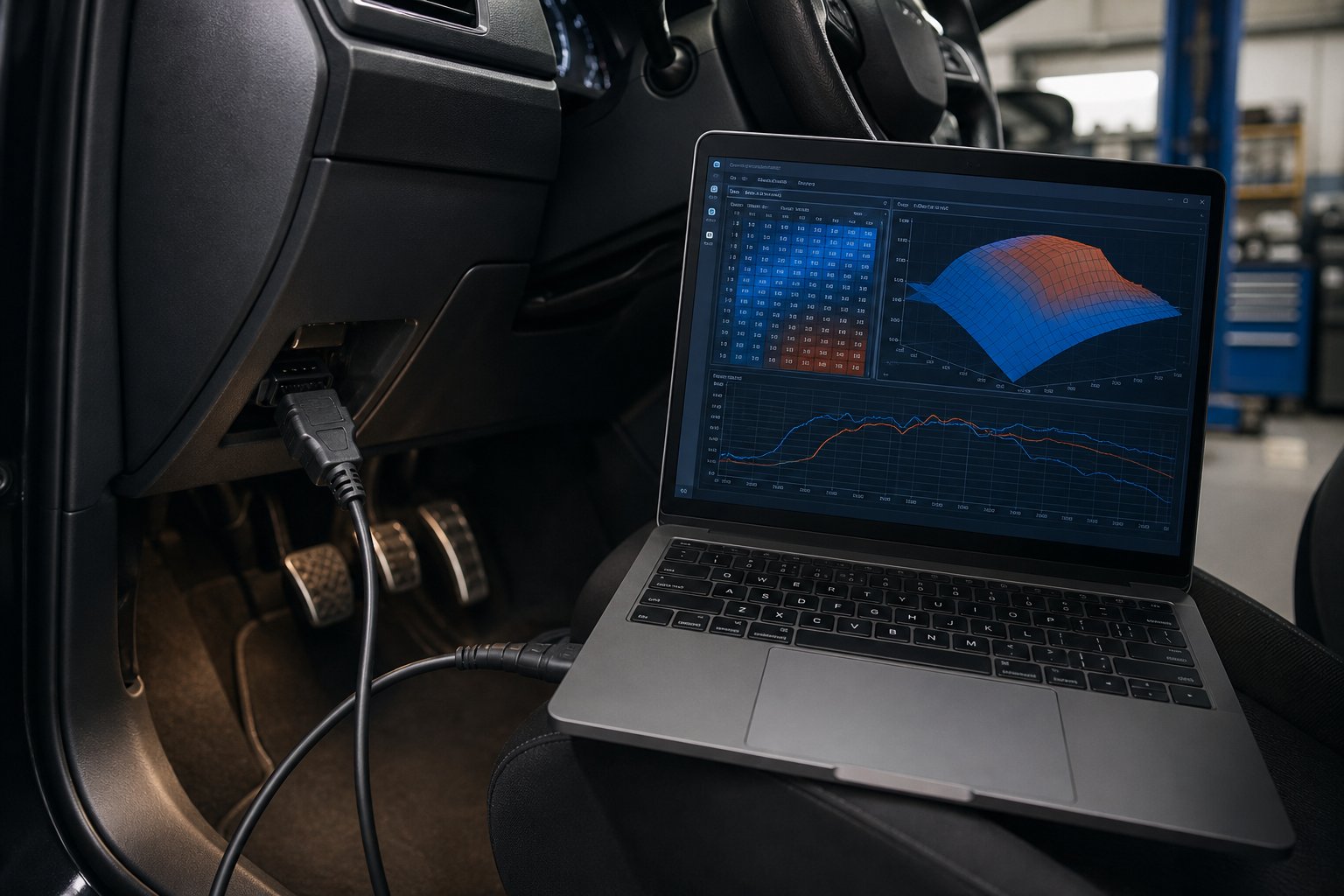
A Stage 1 remap rewrites the software that runs your engine. No new parts, no downtime waiting for a delivery. You book in, the tuner connects to your ECU, writes a new calibration, and you drive away with noticeably more power and torque. It is one of the most cost-effective performance upgrades you can make to a turbocharged car.
But it comes with real obligations. You must tell your insurer. Your manufacturer can still refuse warranty claims on parts the remap damaged. And if the remap touches emissions equipment, you are crossing into illegal territory on a public road. Know those boundaries before you book.
What a Stage 1 remap actually does
Your car’s engine control unit (ECU) is the computer that manages how the engine runs. From the factory, manufacturers set conservative limits on boost pressure, fuel delivery, ignition timing and torque output. They do this to cover a wide range of fuel grades, climates and service intervals, and to protect components across a long warranty period.
A Stage 1 remap adjusts those parameters within the capability of the standard hardware. No intercooler upgrade, no new injectors, no turbo swap. The tuner reads the existing map, writes a revised calibration with higher boost targets and optimised fuelling and ignition curves, and flashes it back to the ECU. The engine produces more power and torque from the same hardware because the factory calibration was deliberately conservative.
Realistic gains by engine type
The gains vary significantly depending on what is under the bonnet.
Turbocharged diesel engines respond best. A 2.0-litre TDI producing 150 bhp from the factory can typically reach 185 to 190 bhp after a Stage 1 remap, with torque rising from around 340 Nm to over 400 Nm. That translates to stronger mid-range pull and fewer gear changes on a motorway run. Typical advertised gains across turbocharged diesel engines are 25 to 35 per cent more torque and 15 to 25 per cent more power.
Turbocharged petrol engines also benefit meaningfully. A 2.0-litre TSI or TFSI producing 190 bhp can typically reach 230 to 250 bhp on a Stage 1 calibration.
Naturally aspirated engines see smaller peak gains. There is no boost pressure to raise, so the tuner has less to work with. The benefit tends to show in throttle response and mid-range driveability rather than headline figures.
Across turbocharged engines in general, advertised UK tuner ranges sit at roughly 20 to 40 hp for small units (1.0 to 1.6 litres), 30 to 60 hp for medium units (1.8 to 2.5 litres) and 40 to 80 hp for larger units (2.5 to 3.5 litres).
These figures come from UK tuner advertising, not independently dyno-verified third-party testing. The actual result depends on your car’s condition, the fuel grade you run and the quality of the tuner’s calibration. Treat the ranges as a realistic guide, not a guarantee.
UK Stage 1 pricing typically runs between £200 and £500. That is a market range based on current tuner rates, not a fixed price. Get a quote specific to your vehicle.
Is it legal in Great Britain?
Remapping the ECU is legal in Great Britain. The Road Vehicles (Construction and Use) Regulations 1986 contain no provision that prohibits modifying your engine’s software.
The hard legal line is emissions. A remap that deletes or disables emissions equipment is illegal for use on public roads. Regulation 61A of the Construction and Use Regulations, which applies to vehicles first used from 1 January 2001, requires that vehicles in use meet the Euro emissions standard they were built to. Vehicles found to have had emissions equipment removed can be fined and deemed unroadworthy. The DVSA In-Service Exhaust Emission Standards set the test parameters applied at the British MOT.
One important boundary: the 2008 amendment regulations to the Construction and Use Regulations extend to Great Britain only and do not apply to Northern Ireland, which operates a separate vehicle testing regime under the DVA rather than the DVSA. If you are based in Northern Ireland, confirm the rules with a local specialist.
Also worth knowing: passing an MOT does not make a non-compliant modification road-legal. A car can hold a valid MOT certificate and still breach Construction and Use Regulations at the point it is driven. An MOT pass is not a legal defence.
Insurance: you must disclose
This is not optional. You are legally required to inform your insurer of any modification to your vehicle, including an ECU remap. Insurers treat a remap as a material fact. Failing to disclose it is a material misrepresentation.
The consequence of non-disclosure is serious. The Financial Ombudsman Service has upheld an insurer voiding a policy and refusing a claim after discovering an undeclared remap following an accident. You would be left personally liable for costs. That is not a theoretical risk.
The premium impact varies. Some insurers apply a small surcharge for a performance modification. Some apply nothing. Others decline to cover the vehicle at all. Shop around before you remap, not after.
You do not need to notify the DVLA. The V5C has no field for software modifications, and a remap does not alter your vehicle’s registered specification or tax band.
Warranty: the accurate position
You will see tuners claim that block exemption regulations make it illegal for a manufacturer to void your warranty because of a modification. That claim is overstated. Block exemption is competition law governing agreements between businesses. It says nothing about consumer warranties and nothing about modifications.
The current UK instrument is the Competition Act 1998 (Motor Vehicle Agreements Block Exemption) Order 2023, SI 2023/501, which came into force on 1 June 2023 and ceases to have effect at the end of 31 May 2029. What it does is prevent a manufacturer from making main-dealer servicing or own-brand parts a condition of keeping your warranty. Having your car serviced by an independent garage does not, by itself, put your warranty at risk.
What it does not do is stop a manufacturer refusing a claim on a component that your modification damaged or contributed to damaging. A UK dealer can refuse to cover a powertrain failure if they can demonstrate the remap caused or contributed to the fault. Modern diagnostic tools, including flash counters and calibration version number checks, make a remap straightforward to detect.
On VW Group vehicles specifically, the ElsaPro diagnostic system applies a TD1 flag to the VIN when it detects a non-factory ECU map. Once that flag is set, powertrain warranty claims across VW, Audi, SEAT and Skoda are almost always blocked.
The remap does not void your entire warranty. If your electric window motor fails, the manufacturer cannot refuse that claim on the grounds that you have a remap. The test is causation. Unrelated faults remain covered.
What is still unknown
Enforcement of Regulation 61A is subject to active government consultation as of late 2026. Stricter roadside emissions checks or expanded MOT testing could change how remaps are policed. The current enforcement position is not fixed.
There is no independent, standardised benchmark for “Stage 1” gains. Every tuner defines the term differently, and published figures are self-reported. Until an independent body verifies these claims, treat advertised power numbers as indicative.
Who this suits
A Stage 1 remap suits any turbocharged car owner who wants more performance from the existing hardware without spending on physical modifications. It is particularly effective on turbocharged diesels and offers strong value for the outlay. If your car is still within the manufacturer warranty period and you care about retaining powertrain cover, weigh that trade-off carefully before booking.
What to do next
Get a quote from a reputable UK tuner who will show you before-and-after dyno figures. Check whether your specific ECU can be mapped reversibly. A tuner who can restore the factory map gives you more options down the line. Contact your insurer before the remap is done, not after. And if your car is VW Group and under warranty, understand the TD1 flag consequence before you commit.
Know the numbers you can hit. Know what happens if you go over. Then decide.