The short answer
Most sensible mods pass an MOT without drama. The ones that fail do so because builders either did not know the exact rule or convinced themselves the tester would not notice. Here is what the rules actually say, area by area, so you can build with your eyes open.
This article covers England, Scotland and Wales. Northern Ireland uses different legislation and is tested by the Driver and Vehicle Agency at official DVA centres, not private garages. The first test there is also required after four years, not three. If you are building in Northern Ireland, check the Motor Vehicles (Construction and Use) Regulations (NI) 1999 separately.
Where the rules come from
The rules themselves are set out in the DVSA MOT Inspection Manual and the Road Vehicles (Construction and Use) Regulations 1986. Both are living documents that receive periodic updates, and those updates are logged publicly on the MOT Manual updates page. What follows is the current state of play for the modifications most likely to trip you up: exhausts, emissions, suspension, lights, tints and number plates.
What the MOT checks, area by area
Exhausts and noise
There is no fixed decibel number baked into the MOT test itself. The figures you see quoted across forums typically relate to type-approval drive-by limits, not the pass/fail threshold on the ramp. What Regulation 54 of the Road Vehicles (Construction and Use) Regulations 1986 actually says is that every car must have a silencer, the silencer must be in good working order, and you must not alter the exhaust system in a way that increases the noise made by escaping gases.
During the MOT, a tester can fail your car if it emits noise unreasonably higher than a similar vehicle fitted with a silencer in average condition. The DVSA MOT Inspection Manual does not give you a dB figure to aim for. The standard is comparative and subjective. A raspy cat-back that sounds savage on video may still pass, while a poorly silenced straight-pipe will not.
On the road, police can use Regulation 54(2) or Regulation 97 of the same legislation to pull you over and issue a prohibition notice. An MOT pass does not make you untouchable at a roadside stop.
Practical position: a cat-back or axle-back from a reputable brand that retains a proper silencer is low risk. A decat, a straight pipe, or anything with a removable baffle is a gamble. Know which side of that line you are on.
Emissions and the DPF
This one is simple and non-negotiable. Removing a diesel particulate filter or a catalytic converter is illegal for road use and will result in an automatic MOT fail. No exceptions, no grey area. Diesels also go through a smoke opacity test, and black smoke is an instant failure. The DVSA MOT Inspection Manual confirms these requirements.
If you run a diesel build with a removed DPF and somehow scrape through a test, you are still committing an offence every time the car is on a public road.
Suspension
Lowering your car does not automatically fail an MOT. What does fail is suspension that is insecure, excessively worn, or incorrectly fitted. The DVSA MOT Inspection Manual covers axles, wheels, tyres and suspension in Section 5, and it was updated in November 2024 to add new information on retaining and locking devices under Section 5.3.6. Check the live manual for the current defect wording before you book a test on a freshly built setup.
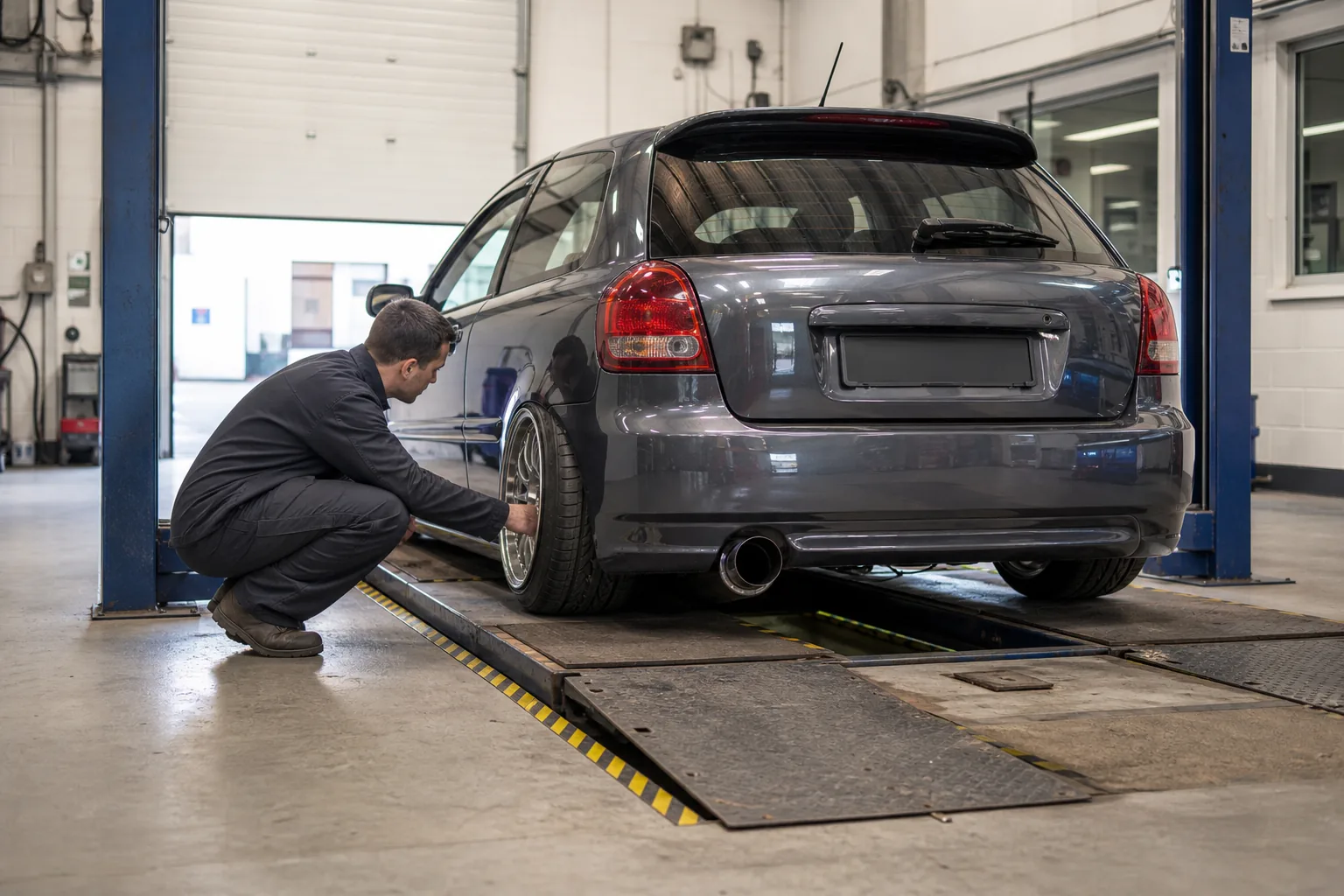
The bigger risk with a lowered car is indirect. Drop your ride height and you change your headlight aim. Testers check headlight alignment separately, and a car that has been slammed without readjusting the headlights will fail on lights, not on ride height.
Coilovers and air ride are both fine in principle, provided the hardware is properly secured and the geometry is set correctly after fitting. Get it corner-weighted and aligned after any significant suspension change.
Lights
The DVSA MOT Inspection Manual, Section 4 covers lamps, reflectors and electrical equipment. Headlamps must emit white light, predominantly white with a blue tinge, or yellow. Anything else is a fail.
Headlight tint films that reduce light output are illegal and will fail the MOT. That includes the heavily smoked vinyl wraps that look dramatic in photos.
A 2024 update to the manual clarified the rules on daytime running lamps. Vehicles do not need to be fitted with DRLs if the DRLs do not have linked front and rear position lamps, or if those lamps have been permanently disconnected, painted over or masked, as long as the vehicle is only used during daylight hours and not in seriously reduced visibility. If you have deleted or masked DRLs and you drive at dusk, you are outside the rules.
Window tints
The numbers here are fixed. Your windscreen must allow at least 75 per cent of light through. Your front side windows must allow at least 70 per cent. Rear side windows and the rear windscreen have no legal minimum, so you can go as dark as you like back there.
If your front glass is too dark, the MOT is an automatic fail. Police and DVSA can also issue a prohibition notice at the roadside, with a fine on top.
Number plates
Non-compliant plates will fail an MOT. Smoked or dark-tinted plates violate British Standard BS AU 145e, which came in during September 2021. Fines for non-compliant plates can reach £1,000.
Northern Ireland and other differences
The MOT test applies across England, Scotland and Wales. Northern Ireland operates under a separate system administered by the DVA, with its own testing schedule and centres.
Who this applies to
Anyone building a modified car for road use in Great Britain. If you are fitting an exhaust, lowering suspension, swapping headlights, applying tints, or running a diesel with emissions hardware, you need to know these rules before you book a test. Track-only builds are exempt from all of this, but if the car ever touches a public road, it is not track-only.
What is still uncertain
Emissions testing is expected to become stricter, with potential closer scrutiny of catalytic converters, DPFs and AdBlue systems in modern diesels. As of the time of writing, these are unconfirmed changes. Keep an eye on the MOT Inspection Manual updates log if you run a newer diesel or a car with a complex emissions setup.
It is also unclear whether future updates will introduce any fixed dB threshold for exhaust noise testing. The current standard remains comparative and subjective.
What to do next
Before your car goes on the ramp, work through this list.
Check your exhaust has a functioning silencer and that it is not noticeably louder than stock. If it is, that is your risk to own.
If you have lowered the car, get the headlights re-aimed. Book a geometry check while you are at it.
Measure your front window tint with a light transmission meter if you are not certain of the percentage. They cost very little and remove all doubt.
If you run a diesel, do not touch the DPF. If it is already gone, the car should not be on the road.
Check your number plates against BS AU 145e. If they are smoked, swap them before the test.
Read the current live version of the DVSA MOT Inspection Manual for any section you are unsure about. It is free, it is plain English, and it is the actual document your tester works from. There is no excuse for not knowing what is in it.