
The short answer
A poorly fused or undersized power cable is not just a wiring fault. It is a fire waiting to happen. UK law requires every aftermarket electrical circuit to be fused, the MOT tester can fail your car on wiring alone, and your insurer can walk away from a claim if you did not declare the modification. None of that is scaremongering. It is just the spec sheet.
Where the rules come from
What follows is a safety explainer covering the legal requirements, technical principles and common mistakes that apply to every car audio power cable and fusing decision in the UK. The rules have not changed recently, but the number of cheap kits on the market has, and the mistakes keep repeating.
What the law and good practice require
The underlying law has been in place since 1986. Regulation 34 of the Road Vehicles (Construction and Use) Regulations 1986 (SI 1986/1078) requires that every electrical circuit in a motor vehicle includes a fuse or circuit breaker. That covers your amplifier power feed. There is no exemption for aftermarket installs.
The MOT adds a second layer. Under Section 4.11 of the DVSA MOT Inspection Manual, testers carry out a visual inspection of all visible wiring. Wiring damaged to the point of likely causing a short circuit is a Major defect. Wiring insulation posing an imminent risk of fire or sparks is a Dangerous defect, meaning an immediate failure and the car cannot be driven away. An MOT pass does not mean your install is safe or legally compliant beyond the items visually checked. It is a snapshot, not a sign-off.
What has changed in practice is the flood of copper-clad aluminium (CCA) cable sold at OFC prices. CCA delivers roughly 61 per cent of the current capacity of OFC at the same labelled gauge. A 1/0 AWG OFC cable carries around 175 A. A 1/0 AWG CCA cable carries around 107 A. That gap gets worse because some CCA cable labelled as 1/0 AWG lists an actual conductor cross-section well below the 53.5 mm squared of a genuine 1/0. If the product lists 40 mm squared or less, it is performing closer to 2 AWG OFC. CCA is not illegal, but if you buy it thinking you are getting OFC ampacity, your fuse sizing and wire gauge calculations are both wrong.
Cable, kits and what they cost
Wiring kits using genuine OFC cable typically cost more than CCA equivalents. Check the actual conductor cross-section in mm squared before buying anything, regardless of price.
Who this applies to
Anyone fitting an aftermarket amplifier, running a new power feed from the battery, or upgrading from a basic wiring kit needs to read this. The mistakes below apply equally to a single two-channel amp install and a multi-kilowatt competition build.
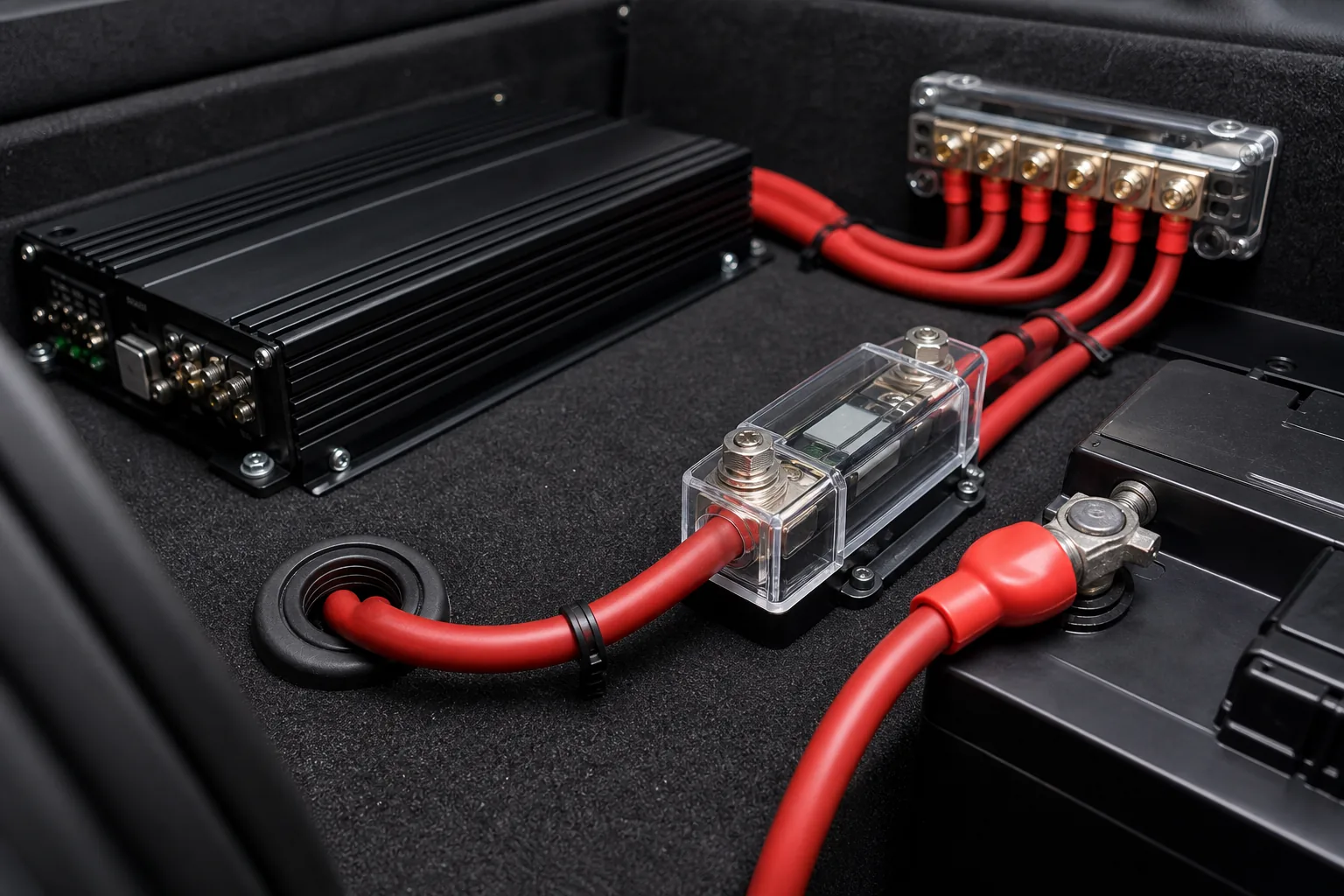
The number one mistake: no fuse at the battery. Every power cable running from your battery to an amplifier or distribution block needs a fuse, and it needs to be within roughly 30 cm of the battery terminal. That 30 cm figure is a widely cited trade convention rather than a statutory measurement, but the principle is grounded in SI 1986/1078. If the wire comes loose and touches the vehicle body or the negative terminal, a large current flows instantly. Without a fuse, the cable jacket melts and you have a fire. The fuse at the battery protects the wire itself. The cable must also pass through the bulkhead via a proper rubber grommet. A bare hole in sheet metal will eventually cut through the insulation and short the wire to chassis.
The second mistake: sizing the fuse too large. Fuses blow because something is wrong. The fix is not a bigger fuse. Upsizing a fuse to stop it blowing is how fires happen. Size the battery-end fuse for the wire, not for the amplifier’s rated draw.
Choosing the right wire gauge. The following figures are indicative for OFC cable on short runs and should be verified against your specific cable’s datasheet:
- Under 600 W RMS: 8 AWG, rated around 50 A
- 600 to 1,200 W: 4 AWG, rated around 125 A
- 1,200 to 3,000 W: 1/0 AWG, rated around 200 A
- 3,000 to 5,000 W: 2/0 AWG, rated around 240 A
Source: Audio Intensity installer guide. Treat as guidance and cross-reference your cable manufacturer’s data.
The ground cable must be the same gauge as the power cable, connected to a clean, bare metal point on the chassis. An undersized or corroded ground does not just hurt sound quality. It forces the system to work harder and can damage the amplifier.
Routing errors that cause fires. Running wires near sharp edges, hot surfaces, or moving parts such as seat tracks can damage insulation over time. The DVSA MOT defect criteria explicitly list wiring likely to contact hot or rotating parts as a Dangerous defect. Keep RCA cables on the opposite side of the vehicle from the power cable.
Multi-battery systems. If you are running a secondary battery, every connection between battery banks needs its own fuse. Place a fuse within 15 to 45 cm on each side of every battery bank.
Insurance. Not telling your insurer about the modification is one of the most common mistakes in UK car audio installs. Undisclosed modifications can void a policy at the point of claim. In 2022 there were 18,991 road vehicle fires in Great Britain, and electrical faults including short circuits and high currents in unfused conductors are among the recognised causes of vehicle fires. No published UK figure isolates aftermarket audio wiring specifically, and I am not going to invent one. The point stands without it.
What is still uncertain
- No published UK statistic breaks out aftermarket audio wiring as a specific cause of vehicle fires. The overall fire figures are clear; the audio-specific data does not exist in public sources.
- The 30 cm fuse placement figure is trade convention, not a statutory measurement. It is widely adopted but not codified in SI 1986/1078.
- MOT testing standards in Northern Ireland are administered by DVA separately from DVSA in Great Britain. The principles are largely parallel, but specific defect categories may differ.
- BS 7671 (the IET Wiring Regulations) governs fixed domestic and commercial electrical installations. It does not govern vehicle wiring. Do not rely on it for car audio.
What to do next
Here is the practical checklist before you power anything up:
- Fit a correctly rated fuse within 30 cm of the battery terminal on the power cable.
- Route the cable through a rubber grommet wherever it passes through the bulkhead.
- Size the fuse to the wire’s ampacity, not to the amplifier’s rated draw.
- Match the ground cable gauge to the power cable gauge and connect to bare metal.
- Confirm whether you are buying OFC or CCA, and check the actual conductor cross-section in mm squared.
- Route all cables away from sharp edges, heat sources and moving parts.
- Declare the modification to your insurer before the first drive.
If you are still working out whether you need an amplifier at all, the guide on whether you need a dedicated car amp covers that from the beginning. If you are adding speakers at the same time, the article on upgrading car speakers without changing the head unit is worth a read alongside this one.
Get the wiring right first. Everything else is secondary.